Updated October 2026 · sources at the end
Side by side
| Penjing 盆景 | Bonsai 盆栽 | |
|---|---|---|
| Origin | China; shown in tomb murals of the 2nd and 3rd centuries | Japan, from penjing brought over around 700 (Huntington) or in the 10th century (Montreal Botanical Garden) |
| The word | "Scene in a tray" (pénjǐng) | "Planting in a tray" (bonsai) |
| Subject | Often a whole landscape; also single trees | A single tree, or a forest of trees |
| What goes in the tray | Trees, rocks as mountains, water, soil, moss, and small figurines of people, boats or pavilions | The tree and its soil, sometimes moss or a stone; figurines are rare |
| Feeling | Natural and "wild"; it can exaggerate nature, with twists and odd angles | Subtle, internal and contemplative |
| Kinds | Tree, landscape (rock) and water-and-land penjing | Classed mostly by size and by the tree's shape |
| Ties to art | Called "three-dimensional painting"; Ming and Qing penjing copied painters' compositions | From the 12th century, shaped by Zen ideals of simplicity and sobriety |
| Schools | Regional: Lingnan, Yangzhou, Suzhou, Shanghai, Sichuan and more, each with its own technique | A shared vocabulary of styles and rules across schools |
The biggest difference: a scene, not a tree
The Montreal Botanical Garden, whose collections are among the largest of bonsai and penjing anywhere outside Asia, puts it plainly: unlike a bonsai, "which is a single tree or a forest in a container, a penjing evokes an entire landscape by including elements ranging from ponds to stones and figurines". Penjing's own classes say the same. Of its three kinds, only one, tree penjing (树木盆景), is about the tree; the other two are about mountains and shores (the three kinds of penjing).
Wild versus restrained
At the Huntington Library, which shows both side by side, the bonsai curator Ted Matson describes bonsai as "more subtle, internal, and contemplative", while penjing "can be more extreme": it can replicate exaggerated things seen in nature, like corkscrew twists and odd angles. The Chinese garden's curator adds that penjing are often more natural, or "wild", looking.
Practitioners often describe the same contrast in terms of rules: bonsai works within a strong shared set of conventions, while penjing leaves more room for personal expression. That is a generalisation, not a law; there are wild bonsai and formal penjing.
Where the line blurs
- Bonsai is, in a sense, tree penjing. The penjing master Zhao Qingquan has said that bonsai is essentially the same as shùmù penjing.
- The influence ran both ways. According to the Huntington's curators, modern penjing absorbed bonsai ideas, especially after the Cultural Revolution, and in the United States the two traditions have largely mixed.
- The techniques overlap. Both prune, pinch and bend with wire or fibre. Penjing's Lingnan school stands out for building branches by cutting alone ("clip and grow"), where most bonsai styles lean on wire.
Which one is Mojing?
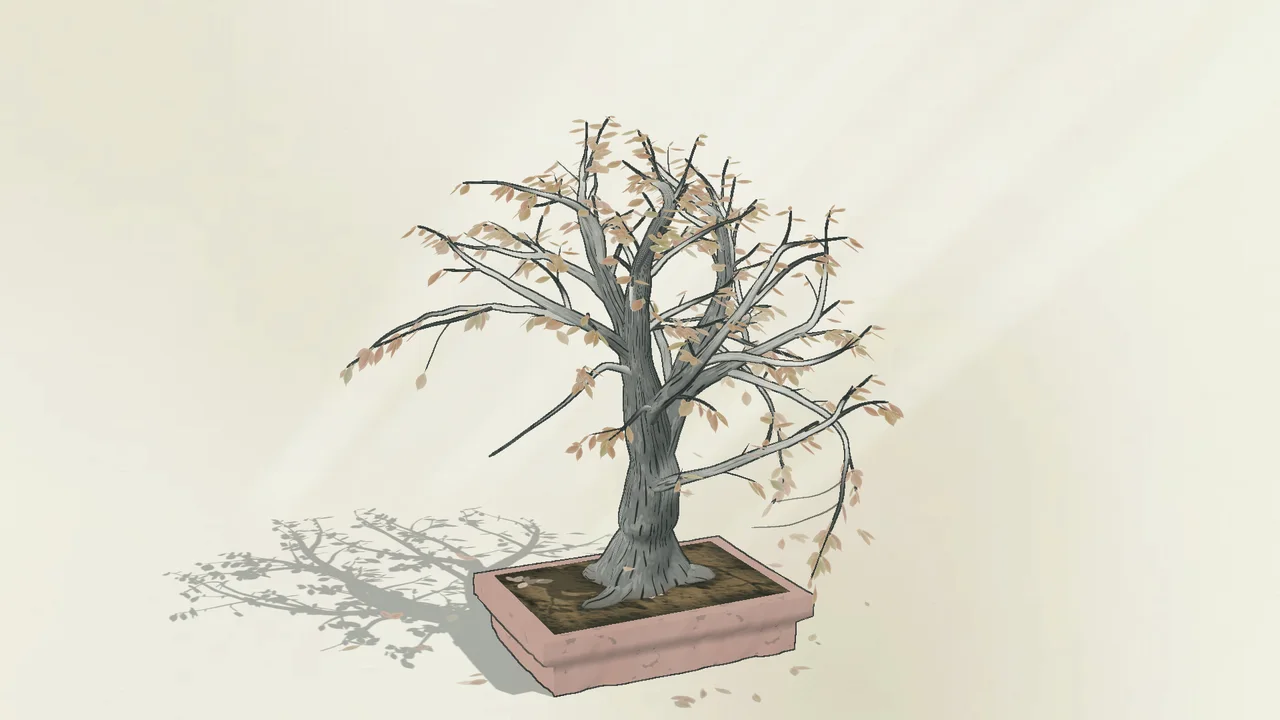
Both, a little. Mojing is a bonsai simulator in the bonsai sense: one tree, a flowering plum, that grows toward the light in real time while you prune, pinch and wire it. But it is drawn as Chinese ink painting, its name is a pun on penjing (盆景 becomes 墨景, "ink scenery"), and you can set stones, moss and grass around the tree, the first step from a tree toward a scene.
Sources
- The Huntington Library, "The Art of Penjing" (Verso), quoting Phillip E. Bloom and Ted Matson: huntington.org/verso/art-penjing
- Espace pour la vie, Montreal Botanical Garden, penjing collection: espacepourlavie.ca
- National Bonsai Foundation, posts on Zhao Qingquan: bonsai-nbf.org
- Bonsai Clubs International, article on the Lingnan clip-and-grow method: bonsai-bci.com/articles/3105
- China Intangible Cultural Heritage Network, entry on penjing: ihchina.cn/art/detail/id/10519.html