 Grow one in ink, free
Updated October 2026 · sources at the end
What the word means
盆 pén is a pot or tray; 景 jǐng is a scene or view. Together, a scene in a tray. The Huntington Library, whose Chinese garden holds a penjing collection, puts it simply: "a landscape or scene in a pot". The important word is scene. A penjing is judged as a picture of nature, not only as a tree.
A short history
- About two thousand years. The Huntington's curator of the Chinese garden, Phillip Bloom, dates penjing in China to roughly 2,000 years ago and notes tomb murals of the second and third centuries that show it. Its exact origins are uncertain.
- The Tang mural. The most often cited early picture is a mural in the tomb of Prince Zhanghuai (Li Xian), at the Qianling mausoleum, where he was reburied in 706. It shows servants carrying miniature landscapes and potted trees.
- To Japan. The Huntington dates its arrival in Japan to around 700, likely with monks, merchants or diplomats; the Montreal Botanical Garden says the 10th century. There it became bonsai, and from the 12th century Zen pushed it toward simplicity.
- Painting in three dimensions. In the Ming and Qing dynasties, penjing were designed to reproduce painters' compositions. China's intangible-heritage register describes potted landscapes and landscape painting as having shaped each other.
The three kinds of penjing
The penjing master Zhao Qingquan, as quoted by the US National Bonsai Foundation, divides penjing into three kinds:
Tree penjing
shùmù pénjǐng. One or more trees in a container, shaped to look old and wild. This is the kind closest to bonsai.
Landscape penjing
shānshuǐ pénjǐng, "mountain and water". Stones cut and set as mountains or islands, often in a shallow tray of water, with small plants.
Water-and-land penjing
shuǐhàn pénjǐng. Trees, rocks, soil and water together, a whole shore in a tray, often with tiny figurines of people, boats or pavilions.
Chinese sources also describe 些子景 (xiēzi jǐng), a very small form that appeared from the Yuan dynasty on.
The regional schools
Penjing has regional schools, each with its own way of shaping a tree. Hong Kong's Education Bureau and China's heritage register both describe five traditional schools: Lingnan in the south, and Sichuan, Yangzhou, Suzhou and Shanghai in the north (the last three once grouped together as the Jiangnan school).
| School | Where | Signature |
|---|---|---|
| Lingnan 岭南派 | Guangdong, around Guangzhou | "Clip and grow" (截干蓄枝, jié gàn xù zhī): branches built by cutting, not bending. Shaped by the Lingnan school of painting. |
| Yangzhou 扬派 | Jiangsu | "Three bends in an inch" (一寸三弯), set with palm-fibre binding; foliage trained into flat "cloud" layers (云片). |
| Suzhou 苏派 | Jiangsu | "Coarse binding, fine clipping" (粗扎细剪); an antique, elegant look drawn from painting. |
| Shanghai 海派 | Shanghai | No fixed formula; metal wire in place of palm fibre, a free style taken from Chinese painting, and a very wide range of plants. |
| Sichuan 川派 | Sichuan | Strong palm-fibre bending, exposed roots "like claws" (悬根露爪), and tall, steep rock landscapes. |
The Education Bureau's sheet also names the Hui school (徽派, Anhui), famous for its "roaming dragon" flowering-plum stumps, and the Tong school of Nantong, an eastern branch of Yangzhou.
How Lingnan clip-and-grow works
Bonsai Clubs International describes it this way: cut the trunk back, let a new bud grow into the next section, and cut again, each section shorter than the last and turning in a new direction. Branches are built the same way. The result has the angular, ever-tapering lines of a tree that has lived a hard life, made without wire. It suits fast-growing trees in a long southern growing season; slow, dense ones are still bent instead.
Penjing and ink painting
Penjing is often called "silent poetry and three-dimensional painting" (无声的诗、立体的画). It borrows its rules from landscape painting: 咫尺千里, "a thousand miles in a foot", and 小中见大, "the large seen in the small". At the Huntington, Bloom describes the shadows of the trees on the garden's white walls as "like an ink painting that is moving on the wall".
Trees used in penjing
Many trees are used; the ones below appear in the lists of the schools and in museum displays:
- Chinese elm (Ulmus parvifolia, 榔榆) and other elms
- Sageretia (雀梅) and Fukien tea (Carmona, 福建茶), staples of Lingnan
- Ficus (榕), boxwood (黄杨), azalea (杜鹃) and orange jasmine (Murraya, 九里香)
- Trident maple (三角枫) and pomegranate (石榴), in Suzhou
- Crape myrtle and Japanese maple, in the Montreal Botanical Garden's collection
- Flowering plum (Prunus mume, 梅), loved across China and the subject of the Hui school's stumps
Penjing in Mojing
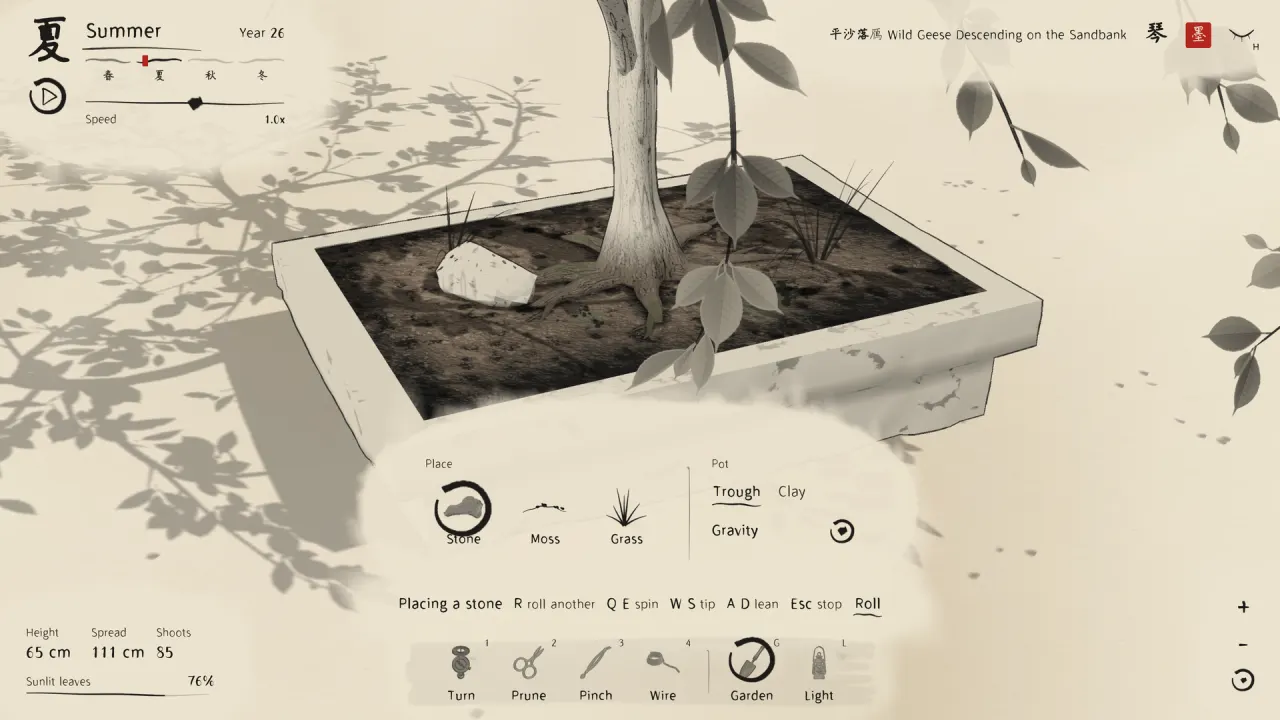
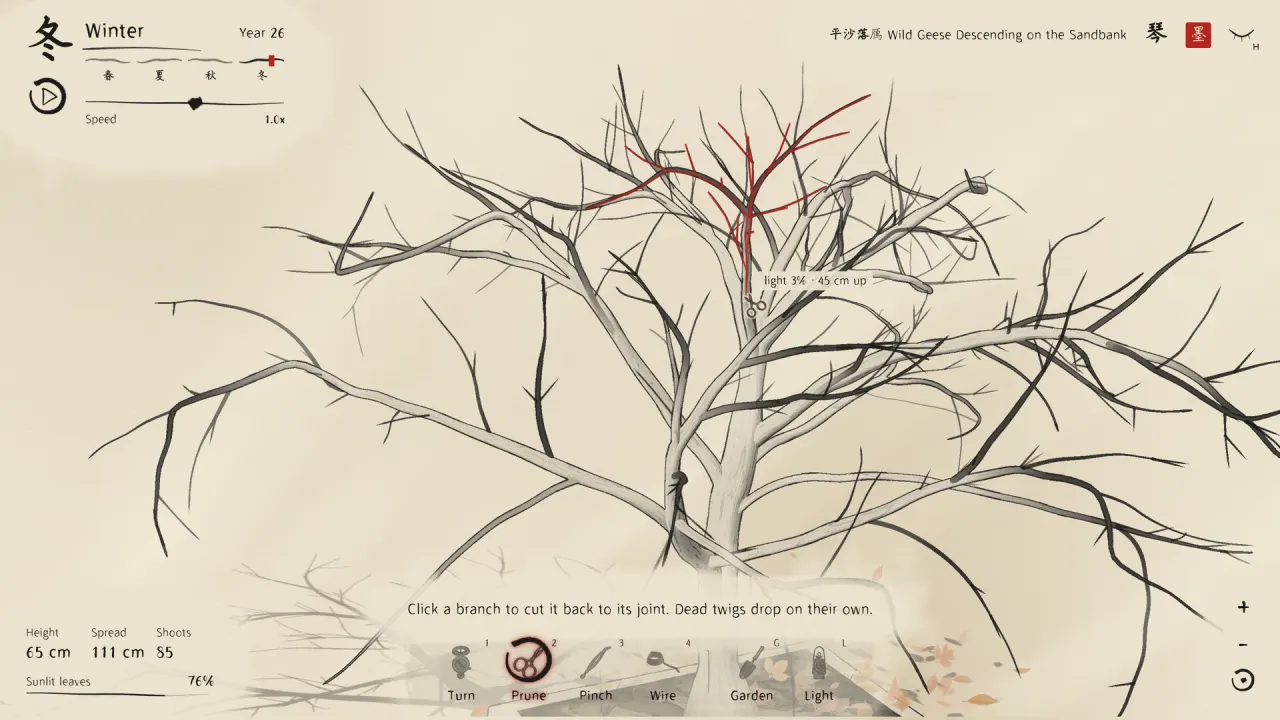
Mojing's name is a pun on penjing: the pot 盆 becomes ink 墨, "ink scenery". It is a bonsai simulator drawn as Chinese ink painting. A flowering plum grows toward the light in real time; you prune, pinch and wire it, then set stones, moss and grass around it in a trough. It is tree penjing, with the first stones of a scene, played in a browser.
Wondering how all this differs from bonsai? See penjing vs bonsai.
Sources
- The Huntington Library, "The Art of Penjing" (Verso): huntington.org/verso/art-penjing
- China Intangible Cultural Heritage Network, entry on penjing techniques: ihchina.cn/art/detail/id/10519.html
- Hong Kong Education Bureau, Nan Lian Garden teaching notes on penjing schools: edb.gov.hk (Ethics and Religious Studies resources)
- National Bonsai Foundation, posts on Zhao Qingquan: bonsai-nbf.org
- Bonsai Clubs International, article on the Lingnan clip-and-grow method: bonsai-bci.com/articles/3105
- Espace pour la vie, Montreal Botanical Garden, penjing collection: espacepourlavie.ca
- Matthaei Botanical Gardens, University of Michigan, "Asian origins": mbgna.umich.edu/asian-origins
- Wikipedia, "Penjing" and "Crown Prince Zhanghuai", for the 706 reburial, citing Hu Yunhua, Chinese Penjing (Timber Press, 1987)